

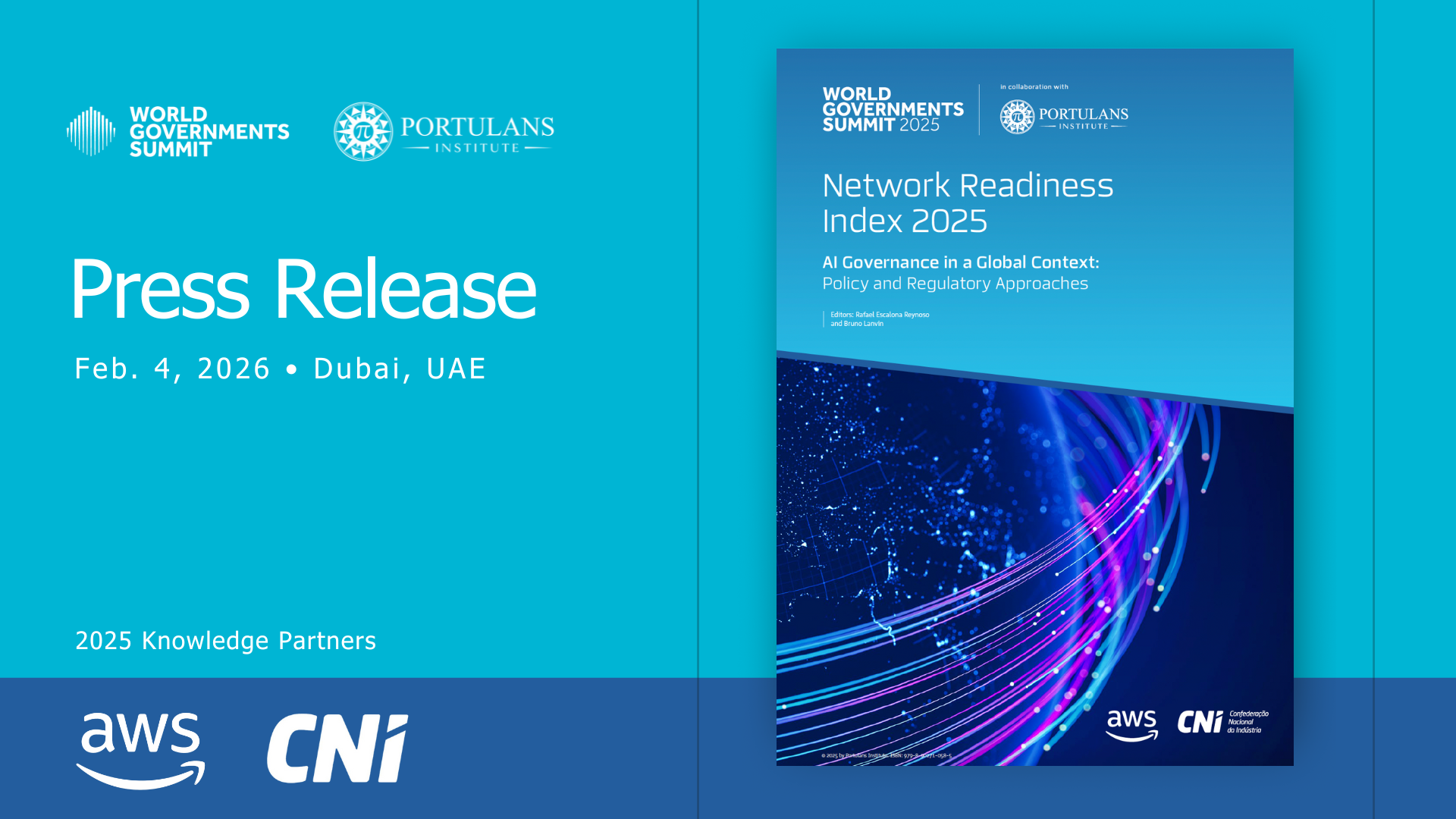
United States, Finland, and Singapore retain top three spots in 2025 Network Readiness Index
For the fourth consecutive year, the United States leads the world in its access to, and use of, digital technologies, the 2025 Network Readiness Index (NRI) published by Portulans Institute finds.
Finland has overtaken Singapore for the second spot. Notable movers in the top ten include the Republic of Korea’s drop from fifth to tenth place, and Denmark’s rise from tenth to fourth place. Meanwhile, Sweden, the Netherlands, Switzerland, Germany, United Kingdom, and Switzerland maintain their positions in the top ten most digitally-ready economies globally.
The NRI is one of the leading global indices on the application and impact of ICT in economies across the world. In this latest edition, “AI Governance in a Global Context: Policy and Regulatory Approaches,” the NRI maps the network readiness landscape of 127 economies on their performances across four pillars: Technology, People, Governance, and Impact, with each pillar comprised of three sub-pillars, and a further 53 indicators.
This year’s edition marks a new partnership with the World Governments Summit, where the NRI was officially launched. The World Governments Summit is a leading global platform dedicated to shaping the future of governance worldwide. Each year, the Summit sets the agenda for the next generation of governments, with a strong focus on harnessing innovation and technology to address the universal challenges facing humanity.
The NRI 2025 reveals a complex global digital landscape where significant disparities exist between regions and development levels. The United States leads with notable performance across technology adoption and innovation metrics, particularly excelling in areas like AI scientific publications, public cloud computing market scale, and digital business transformation.
The top 10 shows limited regional diversity, with Asia–Pacific represented only by Singapore and Korea, and the Americas solely by the United States.The remaining top 10 positions underscore Europe’s dominance in global network readiness.
In 2025 NRI rankings, six economies–Bolivarian Republic of Venezuela, Democratic Republic of the Congo, Chad, Seychelles, Sierra Leone and Yemen–dropped out owing to limitations in data coverage. Year-to-year comparisons of NRI rankings can be influenced by data availability and updates in the NRI model framework.
Rafael Escalona Reynoso, CEO of the Portulans Institute and co-editor of the NRI said:
“The NRI 2025 highlights that digital readiness outcomes increasingly reflect differences in governance quality and institutional execution rather than income level alone. This dynamic is particularly evident in the governance of advanced digital technologies, including AI, where regulatory coherence, public-sector capacity, and implementation choices shape how effectively technological adoption translates into system-wide economic and social outcomes.”
Reflecting on this year’s theme, Bruno Lanvin, co-editor of NRI, said:
“The AI race has entered a new phase. This phase is characterized by the collision of two trends: (1) the now widespread consensus on the transformative power of AI on productivity, employment, innovation and competitiveness, and (2) divergent approaches about AI’s business models (closed or open), and governance (ethical, environmental, informational). Such divergences need to be reconciled before the next wave of changes gathers momentum in technology (quantum computing), society (acceptance, education) and the global economy (access, energy).”
The top performers in NRI 2025 underscore that advanced economies across Europe, the Americas, Asia, and the Pacific continue to outperform in network readiness. Specifically, among the top 25 countries, Europe is represented by seventeen nations – predominantly the Western and Scandinavian regions. East and Southeast Asia contribute four economies – Singapore, Republic of Korea, China, and Japan. Oceania is represented by Australia and New Zealand, and North America includes both Canada and the United States.
Middle- and low-income economies, notably China, Ukraine, Vietnam, and India, have significantly outperformed expectations in digital readiness, achieving scores that exceed their GDP per capita trendlines by at least 10%. Africa and Asia & Pacific lead regionally with the most economies represented, with countries like Kenya, Rwanda, and Uzbekistan also displaying a notable performance. The lower middle-income group shows the largest concentration of high performers, highlighting its prominent role in this ongoing digital evolution.
China notably moves down in the rankings, falling 7 spots to 24th, yet remaining the only middle-income economy in the NRI’s top 25 and continuing to demonstrate technological prowess, particularly in the areas of digital access and engagement in the networked economy.
Ricardo Alban, President of Knowledge Partner Brazilian National Confederation of Industry adds:
“AI regulation in Brazil should be adaptive and human-centered, focusing on high-risk applications and fostering technical and legal interoperability among different national regulatory frameworks. We advocate for clear and proportionate rules that provide legal certainty, stimulate innovation, and ensure Brazilian companies can act as technology developers, not just consumers. With our clean energy matrix and excellence in research, Brazil holds great potential to attract global investment in AI, provided we pursue a path of balanced, harmonized regulation aligned with international best practices.”
In terms of income distribution within the 2025 rankings, 52 countries are high-income economies, 34 are upper-middle-income economies, 32 are lower-middle-income economies, and 9 are low-income economies.
The top performers in the NRI consistently display three significant trends: they are primarily high-income nations, they exhibit strong network readiness across all dimensions and are in the Western or Scandinavian parts of Europe, albeit few exceptions like Singapore, the Republic of Korea, and the United States of America – that leads the global rankings for the fourth consecutive year.
Amazon Web Services (AWS) is a Knowledge Partner for the NRI and has provided research showing how the successful adoption of cloud technology is a key marker for digital readiness and has a positive impact on innovation and the economy at large.
Tanuja Randery, Managing Director of Amazon Web Services (AWS) EMEA, said:
“This arrives at a critical moment when nations are defining how AI will shape their economic and social futures. At AWS, we believe responsible AI adoption requires collaboration—between governments and innovators, across industries, and across borders. The countries that will lead in the AI era are already creating the conditions for innovation to scale through skills development, trusted infrastructure, and policies that enable progress. This year’s report provides essential insights into how nations are building these foundations for inclusive, sustainable growth.”
NRI 2025 – Top 10
| Economy | NRI rank | NRI score | Technology | People | Governance | Impact |
| United States of America | 1 | 79.13 | 1 | 1 | 9 | 16 |
| Finland | 2 | 75.82 | 9 | 10 | 4 | 1 |
| Singapore | 3 | 75.46 | 4 | 4 | 5 | 7 |
| Denmark | 4 | 75.14 | 8 | 17 | 1 | 3 |
| Sweden | 5 | 75.09 | 6 | 11 | 8 | 4 |
| Netherlands | 6 | 75.08 | 3 | 18 | 3 | 5 |
| Germany | 7 | 74.12 | 5 | 9 | 6 | 9 |
| United Kingdom | 8 | 73.85 | 7 | 5 | 13 | 11 |
| Switzerland | 9 | 73.63 | 2 | 15 | 17 | 8 |
| Republic of Korea | 10 | 72.38 | 10 | 2 | 20 | 22 |
Notes to editors:
The Network Readiness Index
Origins of the NRI: Initially launched in 2002 by the World Economic Forum, the NRI was redesigned in 2019 by its founders and co-editors, Soumitra Dutta and Bruno Lanvin, to reflect how technology and people need to be integrated within an effective governance structure in order to have the right impact on our economy, society and the environment. This 2025 edition marks the seventh edition of the redesigned model of the NRI.
The NRI model recognises the pervasiveness of digital technologies in today’s networked world and therefore rests on four fundamental dimensions: Technology, People, Governance, and Impact. This holistic approach means that the NRI covers issues ranging from future technologies such as AI and Internet of Things (IoT) to the role of digital transformation in reaching the Sustainable Development Goals (SDGs).
About the NRI: The 2025 NRI is the seventh edition of a renewed NRI model, and it ranks a total of 127 economies based on their performance across 53 variables.
The 2025 edition of the NRI is published in partnership with Amazon Web Services (AWS) and the Brazilian National Confederation of Industry (CNI)
About Portulans Institute (PI): Founded in 2019 by Soumitra Dutta and Bruno Lanvin, Portulans Institute is an independent nonprofit, nonpartisan research and educational institute based in Washington DC. PI’s areas of expertise include technology competitiveness, innovation readiness, and global talent.
Learn more at https://portulansinstitute.org/
The World Governments Summit is a knowledge exchange center at the intersection of government, futurism, technology, and innovation. It functions as a thought leadership platform and networking hub for policymakers, experts and pioneers in human development.
Learn more at https://www.worldgovernmentssummit.org/
Contacts for Press:
Portulans Institute: [email protected]
World Governments Summit: [email protected]